For the last couple of years, I've lived in Muckle Roe. Being the very nearest place to me to take photos, I have done so....repeatedly! This blog post is a kind of a 'Guide to Muckle Roe' if you will. I'm not much of a travel writer but hopefully you enjoy looking at some of the photos anyway ;)
Coastal Scenery and the Hams
Walking and hiking around Muckle Roe is brilliant. Arguably the best place in Shetland given the density of amazing viewpoints per mile. Once you cross the bridge you are immediately met with a left/right choice as the road splits to the north or south. Should you like to turn right towards the northern end of the island and set off on foot from the end of the road, Otters Ayre is likely to be the first place to stop you to admire the view:

Otter's ayre
Up over the hill and around the coast a little further brings you to Roda Geo. There's a lot of red granite in Muckle Roe (thus the etymology of Muckle Roe - big red island) and the beaches show this with the red coloured sand:

Roda Geo
It's a bit of a climb to get down to the bottom of the Geo but from up top, the view is just as impressive:

Roda Geo
Not much further round the coast you'll reach the Hams area but as most folk approach from the south, that's how we'll look at it now. Walking from the southern end of the road instead there's a hint to the quantity of possible places to see. Each 100m has something in it and to get all the way to the Hams is a great trek!

There's a sign
Walk Shetland recommend the Hams as a place to visit and I fully agree - it's an amazing place. Their route is not one I've followed but it looks like it would offer some great views from the hilltops: http://www.shetland.org/things/outdoor/walking/hams-of-muckle-roe-circular
The Shetland Islands Council have done a great job to improve access to walkers/hikers and have even posted this plaque near the end of the public road giving a suggested route. As this one follows the cliffs and passes the lighthouse, there are some beautiful spots to see:
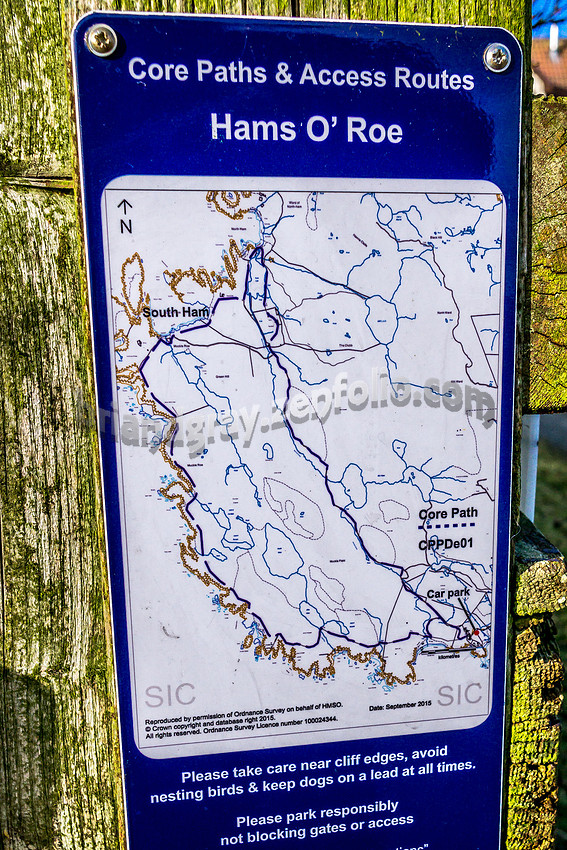
That's the way!
For those not able to make the round trip to the Hams on foot there are lots of small beaches nearby, each with their own character and each are worth visiting. The biggest of these is Muckle Ayre. It's a short walk over relatively easy ground from the end of the road:

Muckle Ayre
Continuing around the coast toward the Lighthouse. Birki Ayre/bay will stop you to admire the view. Sheltered in a bay are a couple of small beaches and more than a few seals:

Birki
Over the next hill, Gilsa Ayre is the next stop. Another example of the red sand that is found around Muckle Roe and again sheltered in it's own little bay:

Gilsa
The original Muckle Roe Lighthouse was constructed in 1897 and replaced with a modern structure in 2001.

NLB A3844 - catchy name


Right beside the lighthouse (to the north) you find the Murbie Stacks. Again, shelter is the key to the interest of this spot. The high sides of the stack, block wind and waves to create localised calm areas making it a great spot to sit and watch seals swimming or birds flying around.

Murbie Stack
'The Hams' themselves are small natural harbours on the North West coast of Muckle Roe. Brilliantly carved out of the coast with sea stacks, caves, arches and crashing waves at the entrances and serene secluded beaches tucked away inside.
The red granite stacks and cliffs bring a bit of colour to the spectacle:
 North Ham

South Ham
The area still shows signs of historical occupation with the ruins of old croft houses giving a hint of what life may have been like. Both here at Burg and the North Ham have old farmsteads to look around. More info on Burg

Burg


Window of a window over South Ham
This mill is a great example of how everything used in old times had to be produced on site - there was no buying in bread from the supermarket. And nowadays, it's a Scheduled Monument: Historic Scotland's record

Horizontal Mill
Winter weather
Apparently, there's no such thing as bad weather, just bad clothing choices. Well this is mostly true - you can still go outdoors during inclement weather provided you have warm coat on... and maybe a hat.... or some gloves.... and maybe a second woollen jumper too, just to be sure. But outside? Yes, of course you can be out!
The coast is much more dramatic when the sea state is confused, waves are crashing and the spindrift fills the air. The exhilaration of seeing a storm hit a coastline is partially caused by our 'fight or flight' response telling us that it looks dangerous. It is dangerous. Thankfully, you don't need to go anywhere dangerous to see dangerous things - the big drops and open vistas allow you to look on from a safe distance.
Still, be careful if venturing out ;)


Stromness
Inland
Moving in from the coast, Muckle Roe is dotted with lochs, each one quiet and each one worth fishing. I can't say I've fished them all but it's certainly another bucket-list item to happily work through.

The Glen

Mill Loch


Gilsa water

Muckla Water

In between the lochs are stretches of active croftland. Some parts are grassy, some parts are covered in heather, some have sheep on them whilst others may have the the occasional cow.

Moooooo!
Always have a look before crossing a fence or passing a gate as to what inhabits the next field. It's advisable to avoid any field with cattle in it - they are very inquisitive and much larger than you might think! Also, if you open any gates, please close them behind you to prevent the animal from getting lost.

The Glen


Dry stone walls and sheep pens are common. I love to have look around these old wall to see the patterns left by the lichen and as they serve as great places for little bits of wildlife to live, you can commonly spot birds hopping around on them.


Wildlife
Muckle Roe's wildlife a very good reason to always have a camera near to hand.
Here, just off of Little Ayre, is a fairly young Humpback whale. Cruising back and forth for periods of time, they can put on a great show:

Humpback
Large cetaceans like Humpbacks can be rare but slightly more common are Orca sightings. Quick and dramatic to watch they are certainly one of my favourites to watch. There are several pods that visit Shetland, transiting north and south while they divide their year between the north of Scotland and as far north as Iceland:

Orca
Smaller still in the cetacean stakes are the Harbour Porpoise - locally know as Neesiks. They're the smallest and most common cetacean found in British waters but still fun to watch. The best conditions to watch them are during periods of flat calm weather. Not only does this help their small fins stand out against any choppy waves, there's great chance of hearing them 'blow' too.

Harbour Porpoise
Like Shetland as a whole, Muckle Roe is a great stopping off point for migratory birds. Here's a short (non-exhaustive) selection of some of the species I've encountered:


Besides the birds, on the ground you'll find hedgehogs and of course, rabbits.

Spiky

Too fluffy
...and if you're eagle-eyed enough, otters are widespread throughout Muckle Roe. I don't think I'm exaggerating to claim that they are everywhere around the coast but the range of one otter family is certainly enough to overlap with other ranges and encompass the whole island and I've seen them in too many places to count. Looking at around low tide in Roesound (near the bridge) will likely be the most fruitful but honestly, they might be spotted anywhere.

Hunting otter
Common and Grey seals are by far the easiest sea mammals to spot. They're both shy and curious in equal parts. When hauled out on the rocks, they don't like to be approached and will head for the sea as soon as they feel your presence getting near. In the water however, they like to watch what you are doing, and will likely keep an eye on you for extended periods - frequently following along if you're walking or kayaking around the coast.

Resting Seal

Nosy Seal
After Dark
As the day finishes and the sun starts to set, there are a few good spots admire the view. Obviously the Hams can be special at any time of day:

North Ham
...but much closer to the road (and easier to access) Roesound is often a wonderful spot for a sunset. The sound runs Northwest - Southeast and as the summer progresses the sun sets in the entrance making the bridge a cracking place to stop and look.

Roesound with sundog

Roesound
After the sun has gone, there's very little light pollution in Muckle Roe which opens the skies up to aurora spotting. Wait for a clear dark night, wrap up warm and get outside. Look to the stars and if you're lucky, the stars won't be the only thing to see:

Orwick
Spotting Aurora is very much a hit or miss game, but on nights like these, it's hard to miss!

North Ham at night
Accommodation
Accommodation can be found are a few different places (in alphabetical order):
Muckle Roe Chapel

Orwick Lodge

Vadsdal B&B
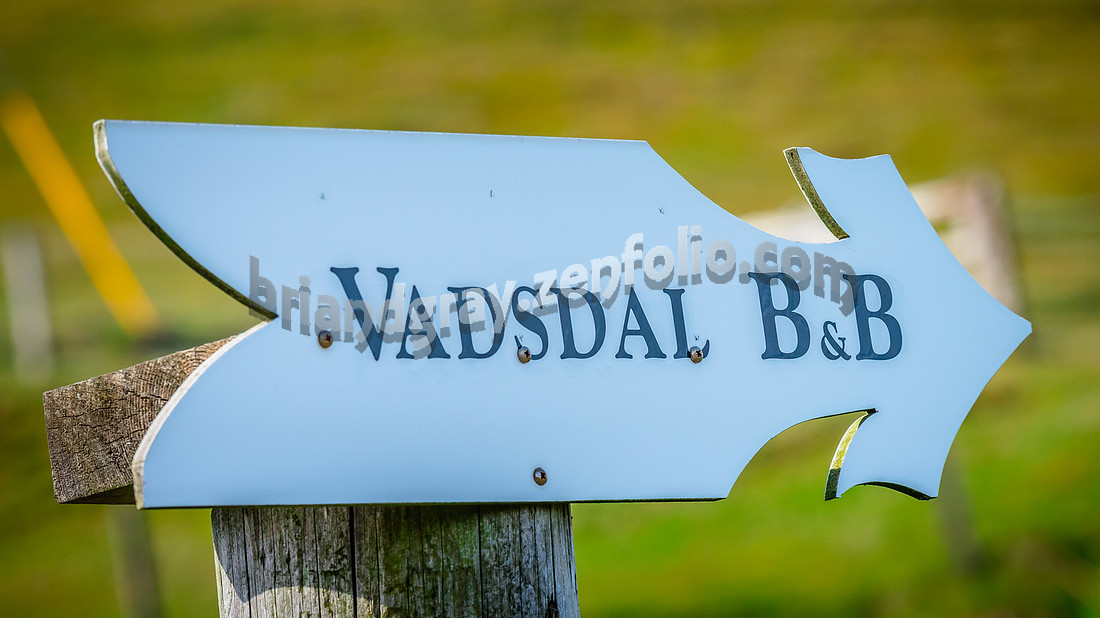
or if all those are fully booked and you are hardy enough, there's always this:

As I said, I'm not much of a travel writer so help me out and leave a few comments about things/places to see in Muckle Roe in the comments section.
Thanks for visiting the page and reading my ramblings, if you want to see few more photos of Muckle Roe - Click here
Brian
]]>
I don't know much about the croft or who runs it but the there is a sign on a gate nearby that greets you with the area's name 'South Collarfirth and Tingon'. The sign then goes on to state 'Managing habitats for biodiversity and actively managing the Tingon nationally important designated site for the benefit of the environment'
If anyone involved in this 'environmental management' ever reads this blog post - hats off to you! The area is thriving with a very diverse number of wildlife species. To list some of what we saw - Red Throated divers, Bonxies, Tirricks, Golden Plover, Merlin, Dunlin, Pipits, Shetland Bumblebees and from the cliff tops, Gannets, Seal and Fulmars.
As well as the 'wild' life, there were Shetland ponies, different breeds of sheep and the odd highland cow! With this in mind, if visiting the area, please respect the good work that has done in fencing off the areas that hold croft/farm animals. Just follow a fence long enough and you will a gate or other safe place to cross.
To our walk - We set off from the end of the track towards Ronas Voe. I'd recommend going this direction (anti clockwise) as it's easier to find your way back to your original start point. Of course, you don't have to do this walk as a 'loop' - you could happily walk one coast one day and the other another time and simply backtrack your course each time.
Passing by the Gossa Water lochs and toward Ronas Voe there are some ruins in the 'Sumra' area - currently only frequented by ponies:

Reaching the west coast of Ronas Voe delivers the first of many great views. There are many stacks, rocks and small geos in this corner of the Voe along a couple of red sand/shingle beaches. The beach to the right of this shot has the interesting name of 'Sannions Ayre' with 'Ship's Ayre' a little further away. Looking at the far left of shot the Voe leads away toward Heylor.

The local geology here has left many stacks on both sides of the voe. Looking across the voe towards Ronas Hill some of the larger stacks are obvious like The Roodrans (nearest) and The Cleiver (in the middle) and Gruna Stack on the left of shot. Fantastic names!

Heading north, up the coast, a fantastic view of the Lang Ayre is possible:

Nearly all round this walk it's possible to see up and down the extended coastline of Shetland's North Mainland. From near the northern most point of the head land, the Island of Uyea (and all it's sea caves) is visible:

Turning the corner at the northern tip I was looking for a landmark that is known as The Faither. I didn't know what I was looking for but I think I found it. Also there, is a wonderful sea stack called Galti Stack and 'The Faither' is an outcrop of land that will someday most likely become a stack similar to Galti. This area was probably the highlight of the walk with plunging sea cliffs, seas stacks, seas birds and panoramic views over the sea, it has a lot to offer someone who likes being near the coast! It's really quite breathtaking!

Turning south you are immediately met with what looks like a never ending series of vertical faced cliffs:

The historical working nature of land is plain to see on the walk south. Here at Heillia a series of dry stone walls leaves us to visualize and wonder about the days when they were in use. I can only imagine that making use of the steep sided ravine, these walls completed series of sheep pens. If anyone know more about their use, please drop me a line!

The abandoned croft at Ockran again leaves you to visualize it's previous life:


The rest of the trip south along the coast is just one geo after the next. At this time of year, many a fluffy young Fulmar can still be seen in the nests which have been made on the ledges. They are easy to spot on the opposite sides of these geos.

Besides nesting sea birds there are many caves to look for:


As I mentioned, views up and down the coast are possible all the way around this walk. In that last photo, above the caves, you can see in the distance another headland with a small object on the top. That little dot is the Eshaness lighthouse!
I hope you get a chance to view these sight for yourself but till then, have a look at the photos I've taken!
http://www.briangrayphotography.com/tigonwalk
Thanks for looking!
Brian
]]>
I've had some great comments from some of you and they are all appreciated.
I've been amazed by how popular it's been actually. People from countries all over the world have been for a look and having such a large audience has been a little scary. Thankfully however, people keep coming back and new people are finding the site every day - so, this little experiment of mine will continue!
Hopefully the next year will be just as much of a success as this and I hope to writing a similarly positive blog post in 52 weeks time.
Thank you for stopping by and as always - 'tell you friends' :)
Brian
]]>Getting there as early as I could was not really early enough. The draw of Europe's biggest fire festival was as strong as ever and spectators from around the globe were there in their droves, lining the streets and surrounding the burn site. I had in my mind where I wanted to be so as to avoid the worst of the wind blown smoke from the hundreds of torches and ultimately was happy with where I ended up - upwind of the burn site but still square on to where the galley would meet it's end.
Before a Viking or guizer could be seen the lighting up process gave me my first shot:

As the procession came past there were the usually mixture of guizers and Vikings, some of whom seemed to have forgotten that Vikings are supposed to have a fearsome reputation:

Not so scary really!
The Galley looked immaculate as always. A testament to the hard work that must go in every year to stage this event:

My vantage point turned out to be pretty good once the Galley had arrived at it's final resting place, even if I was a little ways away from the wall that I wanted to lean against (must get there earlier next year...). Picking my way between the heads of the other spectators, I got a few shots of ol' Boneless himself with his hair blowing in the wind:

Commanding the assembled crowds, he lead the guizers in cheers for all those who had made the event possible and of course, a cheer for Up Helly Aa itself!

To finish off the procession (and kick off the rest of the night!) the Galley was set a light. This also ended my photographic visit to Lerwick for the evening but the UHA season is a long way from over and hopefully this will not have been my last UHA photo of 2014:

]]>
Last night's wind was of a SE'ly direction making for some great waves in Lerwick. Mind you, when I say 'great' I do mean for taking photos and not for walking along the coast. The path along the Sletts was taking a pretty good washing!

The waves weren't confined to that side of the Knab though and round the other side was just as impressive -

I love how the water was pouring back down the steps!
It was not easy to hold the camera with it's big lens in the 40 odd knots of wind though and I couldn't stand around there for long. As you can imagine, there was a fair bit of spray in the air which also shortened the length of time I could stay out. The winter is a long way from finished - more 'crashing waves on rocks' photos to follow? Probably...
Have a good Xmas folks!
]]>
We've had a few gales of late and the seas around Shetland have been whipped up by the winds. I knew there would be some crashing waves to be caught if I could find a suitable venue that was sheltered from the spray. So, I headed out West hoping to find a spot around the Skeld area. Westerwick turned out to be place!
It's the first time I'd been there so imagine how pleased I was to find that, not only were there waves rolling in, but also the high cliffs to the West were keeping the end of the road clear of spray. Jackpot!
